
Spanish CSR projects
The Directorate-General for Health Promotion, Prevention and Health Equity recognises and addresses the Commercial Determinants of Health (CDoH) as a key social determinant of health. A dedicated webpage has been developed on this topic, and it is addressed through a cross-cutting approach aimed at creating health-promoting environments and integrating these considerations into actions undertaken across different areas of work, including alcohol, tobacco, nutrition, breastmilk substitutes, and others.
In the field of alcohol prevention and the reduction of alcohol-related harm, CDoH and conflicts of interest (CoI) are particularly relevant. The health sector must promote, and often lead, intersectoral policies that foster healthy, alcohol-free environments, such as those included in the WHO SAFER initiative.
In this context, the alcohol industry invests considerable effort in maintaining a positive public image and cultivating relationships with different sectors, while seeking to position itself as part of the response to alcohol-related harm. Corporate Social Responsibility (CSR) activities carried out by the industry fall within what have been described as “reputational management practices”[1], that is, efforts to shape legitimacy and credibility, reduce risk, and enhance corporate brand image. Through these actions, the industry presents itself as part of the solution, trying to demonstrate ethical behaviour and concern about alcohol-related harm, while displacing or occupying roles that should be fulfilled by public authorities or other entities free from conflicts of interest.
Key actions and publications developed to address conflicts of interest and prevent CSR-related collaboration with the alcohol industry
Several actions have been undertaken in the alcohol field to address CDoH and CoI, including advocacy and awareness-raising activities, as well as the systematic integration of these concepts into technical documents targeted at national, regional and local levels.
In 2021, the Roadmap for the Prevention of Alcohol Consumption (available in Spanish) was published and endorsed by all regional public health representatives. The document highlighted the need to reach consensus on the role of the alcohol industry, stating that the industry should be excluded from participation in alcohol-related policies and interventions. Guided by this roadmap, the Initiative for the Prevention of Alcohol Use among Minors: Good Practices for Local Authorities was developed and published in Spanish in 2025, together with an English visual summary. One of its four good practices focuses on conflict-of-interest-free prevention policies. The initiative emphasizes the importance of maintaining independence from the alcohol industry, promoting conflict-of-interest-free prevention policies, and avoiding industry involvement in alcohol prevention initiatives targeting minors.
Also in 2021, the advocacy document Information for Policymakers: What Can Public Administrations Do? was published. The document includes the WHO SAFER initiative and specifically highlights the recommendation to protect from interference by the alcohol industry and other sectors with opposing interests.
In addition, key WHO documents have been translated into Spanish and used as advocacy and awareness-raising tools, including the Alcohol Policy Playbook and Reporting about Alcohol: A Guide for Journalists. More recently, a Glossary of Key Terms in Alcohol Prevention (available in Spanish) was developed and agreed upon in collaboration with all Spanish regions and scientific societies. The glossary includes definitions of conflicts of interest, commercial determinants of health, SAPROs (social aspects/public relations organisations), and other relevant concepts.
Furthermore, the Spanish Health Promoting Schools Initiative published a guideline in 2023, jointly developed by the Ministry of Health and the Ministry of Education, Vocational Training and Sports. The guideline advises against collaboration with industries and organisations linked to unhealthy behaviours and recommends consulting the relevant Regional Health Authority whenever doubts arise.
CSR projects identified in Spain through a questionnaire completed with the collaboration of regional-level professionals
1. MENORES NI UNA GOTA
1. Regions
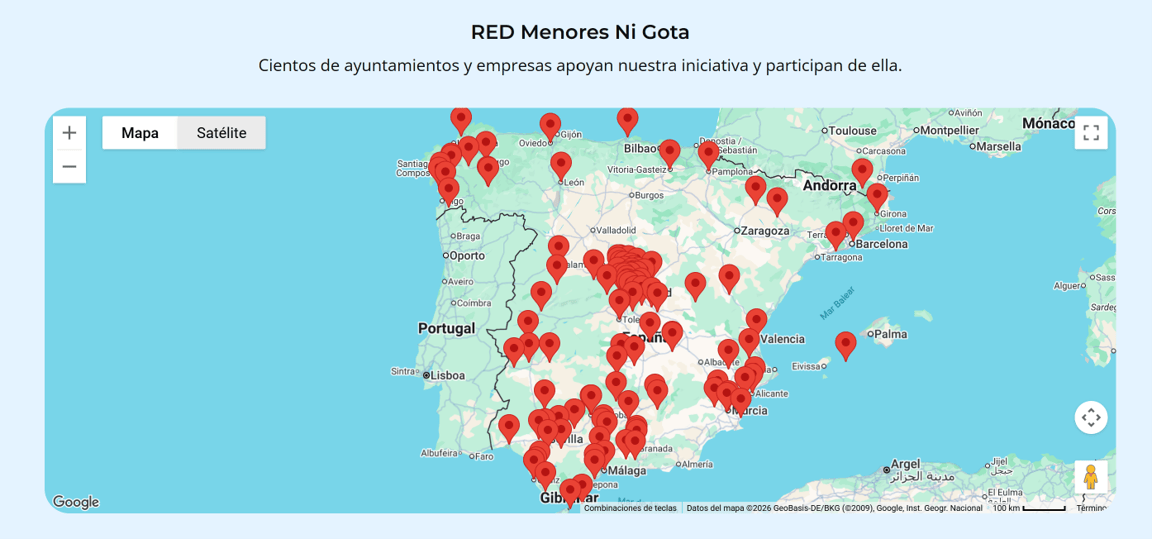
Even though only 3 regions replied to our questionnaire, the website of Menores ni una gota illustrate they are present in many parts of geography. The collaboration is signed with local authorities directly, without participation of the regional health authorities but the support of other sectors like social services or Culture, Tourism, Sport and Youth.
The map below (from their website) shows all the municipalities and companies that support and participate in the initiative.
2. What is the name of the project?
3. Which organization(s) is(are) funding the project?
Spanish Federation of Spirits (with the collaboration of City Council in some cases)
4. Is it known how long the project has been running?
The regions that have responded from 2013, 2024 and 2025, but the project is running since 2001.
There is a Spanish article from 2006 which describes the different actions of the alcohol industries, even though is from several years ago, it illustrates very well the practices and describes the Spanish alcohol sectors: Rodríguez-Martos, Alicia. (2006). A Case Study on Alcohol Policy and the Alcohol Industry in Spain. Nordic Studies on Alcohol and Drugs. 23. 427-444. 10.1177/145507250602300602.
5. Are other organizations or companies involved in the project? If so, which ones?
City Council (social services or Culture, Tourism, Sport and Youth) and Official College of Pharmacists.
6. What is the formal goal of the project or how is it described?
Delay the age at which adolescents start drinking alcohol, should such consumption occur. Reduce the number of adolescents who drink alcohol. Reduce the amount of alcohol consumed by adolescents. Promote the responsible consumption of alcoholic beverages, and prevent consumption among risk groups, such as minors, drivers or pregnant women
7. What is the target group for the project?
Families and minors.
8. What activities are carried out as part of the project?
- Network of cities against underage alcohol consumption.
2. In hospitality venues: “I Do Not Sell Alcohol to Minors” and training in responsible alcoholic beverage service.
3. Talk for parents by a speaker well known for his/her television career “Supernanny” – is a Spanish psychologist and television personality who became famous for helping families address children’s behavioural and parenting challenges on the Spanish version of the TV show Supernanny. - In educational centres: Two-hour face-to-face sessions, the first hour is theoretical and the second practical.
9. Is there a online link to the project and its content? Menores ni una gota
10. Has any feedback c.q. critical comments been provided on the project? If so, by whom and what feedback?
Regional institutions have sent criticism regarding the collaboration of the city council with an entity that promotes the consumption of alcoholic beverages
11. Has the project been evaluated? If so, is the evaluation available?
Yes.
https://alcoholysociedad.org/ofertaeducativa/
In their website they indicate “The Alcohol and Society Foundation, in collaboration with the Deusto Institute on Drug Dependencies, conducted a longitudinal study aimed at evaluating whether the logical and methodological changes introduced into the implementation standards of Menores ni una gota programme, together with modifications related to its management and evaluation, would allow it to be defined as an effective tool for preventing alcohol consumption among underage populations.
The programme was first implemented in 2001 and continues to operate today. Although a meta-evaluation based on previous assessments and partial research conducted throughout the programme’s history had already indicated, among other significant findings, that the programme functions appropriately, is coherent, and achieves a certain degree of success, the purpose of this study was to demonstrate these outcomes through robust and verifiable evidence, thereby increasing the scientific impact of the research.More than 2.7 million students aged 12 to 18 have participated in this programme over its nearly 20-year history.
Assessment from 2010-2011 availabe here
12. Any other relevant data.
No response.
2. SMASHED
1. Region
Unknown, introduced at national level through on-line research.
2. What is the name of the project?
3. Which organization(s) is(are) funding the project?
Diageo.
4. Is it known how long the project has been running?
2023-2024.
5. Are other organizations or companies involved in the project? If so, which ones?
Unknown.
6. What is the formal goal of the project or how is it described?
Students observe, explore, and reflect on key issues related to underage drinking:
· Social and emotional causes
· The impact on young people’s lives
· Social influence and decision-making
· Where and how to help themselves and others
7. What is the target group for the project?
Students from 13 to 17 years old.
8. What activities are carried out as part of the project?
It combines drama with interactive workshops to help young people understand the facts, causes, and consequences of underage drinking, and is presented in two formats: an online learning program and a theatrical performance.
9. Is there a online link to the project and its content?
SMASHED: Educando el futuro sobre el consumo de alcohol en menores
Homepage : Smashed Online – Spain
10. Has any feedback c.q. critical comments been provided on the project? If so, by whom and what feedback?
Unknown.
11. Has the project been evaluated? If so, is the evaluation available?
Unknown.
12. Any other relevant data.
No response.
Conclusion
Identifying and describing alcohol industry CSR activities is essential, as is raising awareness of their ineffectiveness and the potential harms associated with allowing the industry to participate in activities such as alcohol prevention in school settings.
Some countries, including Ireland, have prohibited such practices. It would be necessary for Spain to follow this example, in order to ensure evidence-based prevention free from conflicts of interest across different settings, enabling the creation of healthy and alcohol-free environments in which children can grow, learn and develop, and achieve the highest attainable level of health and well-being.
Since alcohol consumption harms not only the individual who consumes it, but also families, communities and the wider economy, the benefits of reducing alcohol consumption extend throughout society.
Thank you
A special thanks for the collaboration of people from regions in Spain who helped identify the CSR practices.
Inés Zuza Santacilia, Soledad Justo Gil
Prevention Area. General Subdirectorate of Health Promotion, Prevention and Health Equity. General Directorate of Public Health and Health Equity. Ministry of Health.